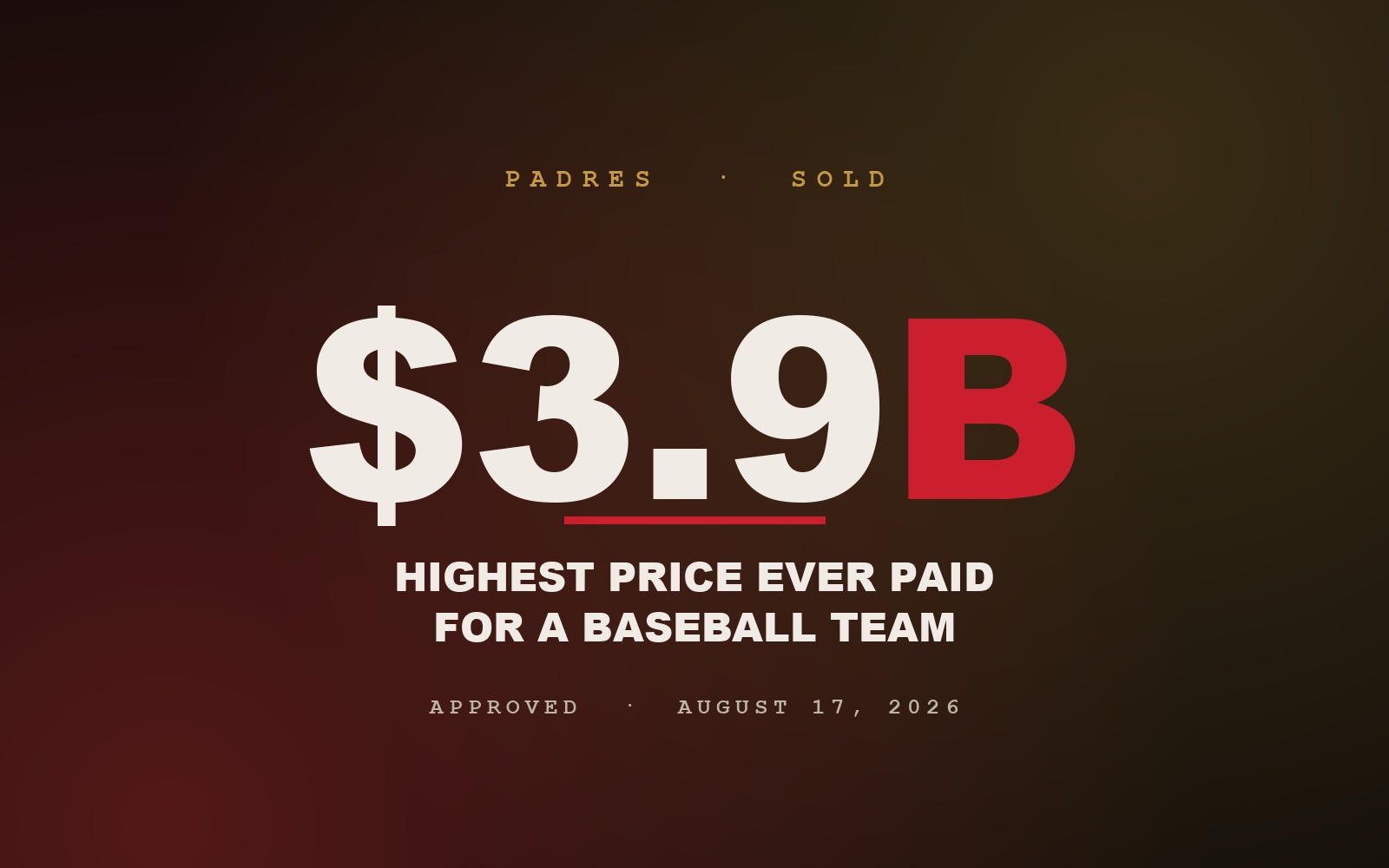
The $3.9 billion sale of the San Diego Padres, unanimously approved by Major League Baseball owners on August 17, 2026, did not begin with baseball. It began with a death and a family fight.
Peter Seidler, the Padres chairman who had turned a mid-market club into a perennial contender by spending aggressively, died in November 2023. He was the reason San Diego punched above its weight, running one of the highest payrolls in the sport in pursuit of a title. His death left two things unresolved: who would control the franchise, and whether anyone would keep writing those checks.
What followed was an estate dispute. Peter's widow, Sheel Seidler, sued her brothers-in-law, led by John Seidler, over the family trust, alleging fraud and breach of fiduciary duty and claiming her late husband had intended for her to take control of the team. Rather than settle the question of ownership in court, the family reached an agreement in February 2026 to explore a sale instead. Selling the franchise, not fighting over it, became the resolution to the inheritance feud.
“We need to win the World Series. It's that simple.”
That is how a championship-caliber baseball team ended up on the open market, and how it drew the highest price ever paid for one. The winning group is led by the private-equity investor José E. Feliciano and his wife, Kwanza Jones. Feliciano, a co-founder of Clearlake Capital, is the designated control person and becomes the first Puerto Rican majority owner in the league. Jones becomes the first Black woman to principally own a Major League Baseball franchise.
The most important thing new ownership brings is the thing the Padres lost when Peter Seidler died: certainty. For nearly three years the franchise ran under a cloud, its future tied up in litigation and grief. A well-capitalized ownership group with private-equity backing ends that. The people who run the baseball side stay in place. Chief executive Erik Greupner and general manager A.J. Preller, who signed a multiyear extension and has never been shy about making a trade to improve his roster, will continue to lead day-to-day operations.
The open question is the checkbook. Feliciano has been blunt about the goal. "We need to win the World Series," he said. "It's that simple." He has been just as blunt about the method, saying the club will "live within our means," a phrase that lands differently in San Diego than it might elsewhere. Under Seidler the Padres spent like a big-market team, carrying a payroll around $220 million, ninth in the majors, despite another frugal offseason. Private-equity owners tend to prize discipline. The tension between winning now and spending sustainably is the story of this ownership before a single pitch is thrown under it.
What the Jones-Feliciano era can do for the Padres, then, is not complicated to name, even if it is hard to pull off: keep a contending window open without the boom-and-bust that unstable ownership invites, back Preller's aggression with real capital, and prove that a team can chase a title and run a sustainable business at the same time. For Jones, whose whole career has been an argument that ownership is the point, it is the largest test yet of the idea.
Read our editorial standards.